Honda Civic Type R FK8 Intake
Import Duties and Taxes not Included outside of the United Kingdom
Overview
The FK8 Honda Civic Type R is one of the fastestfront-wheel-drive cars on the market, but like most modern turbocharged cars,the factory intake has its limitations. The standard system uses a restrictiveairflow path and incorporates features designed to reduce intake noise, which can limit airflow as power levels increase.
The Infinity Design FK8 intake was developed to address these limitations, with a focus on improving airflow and providing enough capacity for highly tuned cars.
The design has been refined using CFD and tested extensively on the dyno. Data logging was also carried out to check that the gains were repeatable and not simply the result of ECU adaptations. The intake was independently tested by Tegiwa Imports and TPW Engineering and the results showed an increase of 18 bhp and 15 lb-ft of torque, along with improved throttle response and a more pronounced intake sound.
The system features a redesigned intake duct with a larger opening and increased internal volume, along with a smooth venturi-profiled inlet tube that extends as close to the turbo inlet as possible. This helps create a smoother, more direct path for the air to travel through. The system includes the largest air filter available for the FK8 platform, providing the airflow
capacity needed for both standard and highly tuned applications.


Design
The Infinity Design intake features a redesigned intake duct with a larger opening and increased internal volume. The original rubber seal against the bonnet is retained, while the cross sectional area from the front air feed to the air filter has been increased.
The factory intake forces air through a 90-degree bend before directing it through a 180-degree turn into the panel filter. From there, the air passes through a short velocity stack within a relatively confined, cuboidal section. The Infinity Design intake takes a more direct approach, allowing air to reach the filter with less than a 45-degree change in direction before entering the main intake volume. The available volume has been maximised to provide an adequate air supply as airflow demands increase.
The intake tube features a gradual transition from the large cross-sectional area of the air filter to the smaller diameter of the MAF sensor. This design helps maintain a smooth airflow path while contributing to improved throttle response and driveability.
The tube also shapes the induction sound. Rather than producing a sharp, abrupt intake noise, it creates the deeper, more substantial induction note characteristic of Infinity Design intakes. The gradual change in diameter gives the tube a megaphone-like effect, helping shape the sound produced by the intake.
The MAF sensor and breather housings are integrated into the carbon fibre intake tube, creating a more robust design and a cleaner, more cohesive appearance, particularly when paired with the Infinity Design carbon fibre turbo inlet.
A custom EPDM coupler is supplied to connect the intake tube to the factory turbo inlet. Its internal profile provides a smooth transition between the larger diameter of the intake tube and the smaller turbo inlet, eliminating an internal lip that could otherwise disrupt airflow.


Performance Testing
The vehicle was tested on a Dynojet 4WD-linked dynamometer within a closed dyno cell, equipped with a front-mounted cooling fan and roof-mounted extraction system. All power figures are reported as wheel horsepower (WHP).
For both intake configurations, the vehicle was brought up to operating temperature and fully heat-soaked before testing. The dyno cell temperature was maintained at approximately 2°C above ambient, with the same cell temperature conditions replicated for both intakes to ensure a consistent comparison.
Each intake was tested with three consecutive dyno runs, with the same test procedure used throughout. The vehicle remained completely stock apart from the intake system and was operated on 99 RON fuel for all testing.
The graph on the left represents the stock intake runs and the graph on the right represents the Infinity Design intake runs.
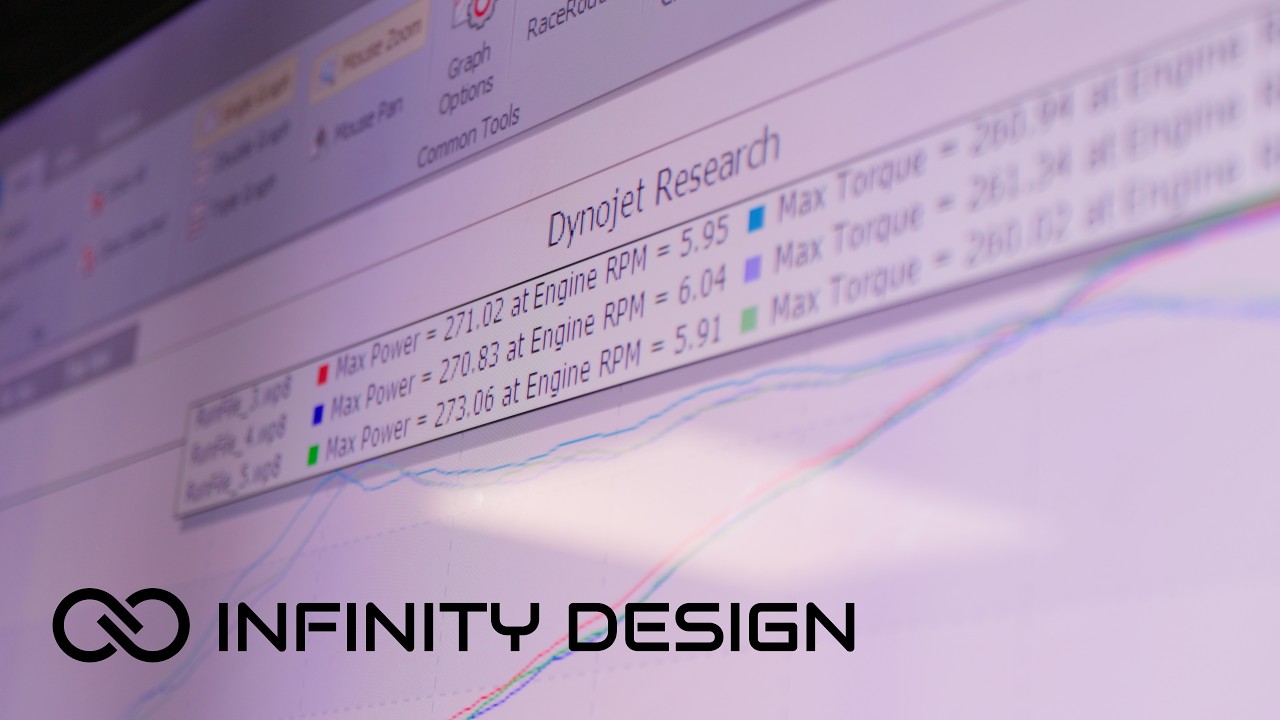
The baseline runs shows a peak output of 233 WHP. While this is slightly below the commonly quoted stock figure of approximately 285 bhp, similar testing has shown that 233 WHP is representative of the typical performance from this vehicle. By comparison, the Infinity Design intake shows a peak power of 273WHP which is an increase of 40WHP over stock.
Across the three runs, the factory intake shows a progressive drop in power, with a peak difference of 9 WHP between the first and final runs. In contrast, the Infinity Design intake demonstrates significantly greater consistency, with a peak difference of just 2 WHP across the same testing procedure.
The dyno cell temperature remained consistent throughout the testing, with the Infinity Design intake being tested at a temperature at least 1°C higher on every run. Despite the slightly higher temperatures, the Infinity Design intake maintained substantially more consistent power output.
This improved repeatability makes the Infinity Design intake particularly well suited to track and drag racing applications, where maintaining consistent performance over repeated runs is critical.


The first comparison looks at the final run from each intake, representing the vehicle in a heat-soaked condition. The dyno graph shows a peak delta of 50 WHP at 6000 RPM, with the Infinity Design intake producing more power from approximately 4500 RPM onwards. This is also the point at which the factory flap opens, allowing hot engine-bay air into the intake and highlighting the restriction within the factory system.
Between 3200 and 4000 RPM, the Infinity Design intake also produces approximately 10 WHP more, indicating improved turbo spool. There is a slight dip in power between 4000 and 4300 RPM of approximately 7 WHP, attributed to the increased intake volume and resulting reduction in air velocity.
The reduction in power after 6800 RPM is due to the throttle closing at higher RPM, a common issue encountered with the G16 engine when tested on a dyno.
Notably, the Infinity Design intake produced these results despite the dyno cell temperature being 1.5°C higher during the test.

Validation
To further validate the results, the Infinity Design intake was tested on a second GR Corolla using the same test procedure. The baseline vehicle produced 236 WHP, just 3 WHP higher than the original car, providing further context for the real-world output of the platform.
The same trends were observed on the second vehicle. The factory intake progressively lost power as the vehicle heat-soaked, while the Infinity Design intake maintained a much more consistent power output across repeated runs. Throttle closure at higher RPM was more pronounced on this vehicle, particularly with the Infinity Design intake; however, this behaviour does not occur during road driving.
Despite the differences between the two vehicles, the results remained consistent. The peak difference between the first runs was 40 WHP, while the difference between the third runs was again 50 WHP. The repeatability of these results across two separate vehicles provides further validation of the performance gains demonstrated by the Infinity Design intake.


Data Logging
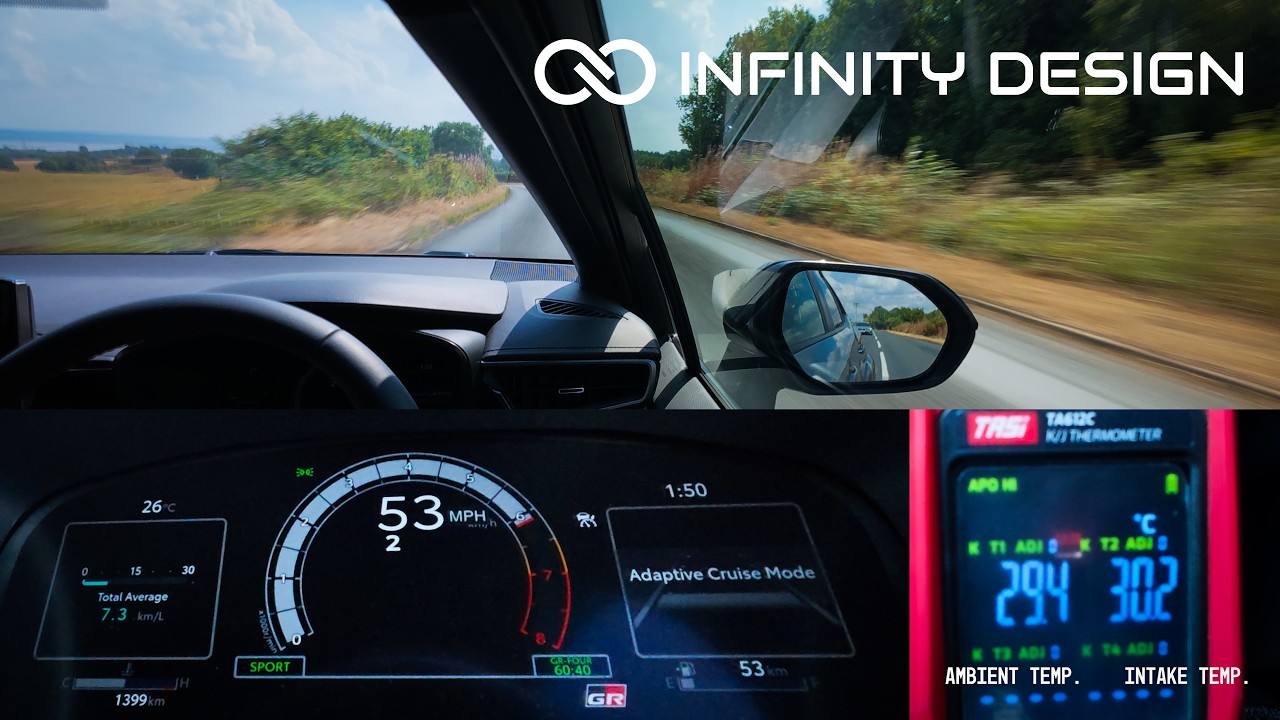
ECUTEK was used to data-log the vehicle with both the factory and Infinity Design intakes on the dyno, providing further validation of the performance results. MAF and manifold temperatures were recorded, with MAF temperatures being particularly relevant as they represent the air entering the intake before intercooler heat soak.
With the factory intake, MAF temperatures continually rise as the system heat-soaks, with a significant increase from approximately 4500 RPM when the factory flap opens and draws in hot engine-bay air. From 4500 RPM to redline, temperatures increase by around 15°C, with a further 5°C increase between the first and final runs.
In comparison, the Infinity Design intake maintains consistent temperatures throughout testing, with MAF temperatures at redline approximately 25–30°C lower than the factory intake. This supports the dyno results, particularly the increased power from 4500 RPM onwards.
Similarly, manifold temperatures remain consistently 10°C lower than with the stock intake. However, temperatures still rise during testing due to insufficient airflow over the intercooler, causing it to heat-soak.


Now the boost and the wastegate duty can be compared. It can be seen that the Boost from 3500 to 4000 RPM is slightly higher than stock and between 4000 to 4500RPM it decreases. This is refected on the dyno graph which shows a slight dip in power in this RPM range. This is due to the volume being much larger which causes the airflow to slow down. However, from 4500RPM onwards, the boost increases significantly with a peak increase of 0.4bar more boost throughout, which translates to the extra power output.
When compared to wastegate duty, the intake is running 10% lower wastegate duty from 2500 RPM to 5000 RPM. Between 5500 and 6500 RPM, the difference is 3% lower, before returning to 10% lower at redline. Despite the lower wastegate duty, boost pressure is higher, showing that the turbocharger is able to produce more boost with less wastegate control. This indicates that the intake system is working more efficiently, with the ECU requiring less wastegate duty to achieve its target.


The air-fuel ratio can next be compared between the stock and Infinity Design intakes. Both systems run close to stoichiometric at lower RPM, before 3500 RPM, at which point both mixtures become significantly richer.
Following this, the stock intake runs at approximately 11.5 AFR, while the Infinity Design intake maintains a slightly leaner mixture of around 12 AFR up to 5500 RPM. From 5500 RPM onwards, the Infinity Design intake returns to 11.5 AFR and remains consistent through to redline.
Although the Infinity Design intake runs slightly leaner than the stock system through the mid-range, the AFR remains significantly richer than stoichiometric under load. This shows that the increased airflow from the intake does not result in an excessively lean mixture, while maintaining the richer AFR required under high engine load.

Videos